Aarhus University Seal

Publications

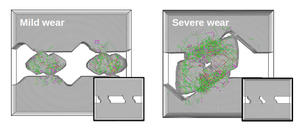
Aghababaei, R., Brink, T and Molinari, J-F (2018) Asperity-level origins of transition from mild to severe wear, Physical Review Letters, accepted.

Abstract: Wear is the inevitable damage process of surfaces during sliding contact. According to the well-known Archard's wear law, the wear volume scales with the real contact area and as a result is proportional to the load. Decades of wear experiments, however, show that this relation only holds up to a certain load limit, above which the linearity is broken and a transition from mild to severe wear occurs. We investigate the microscopic origins of this breakdown and the corresponding wear transition at the asperity level. Our atomistic simulations reveal that the interaction between subsurface stress fields of neighbouring contact spots promote the transition from mild to severe wear. The results show that this interaction triggers the deep propagation of subsurface cracks and the eventual formation of large debris particles, with a size corresponding to the apparent contact area of neighbouring contact spots. This observation explains the breakdown of the linear relation between the wear volume and the normal load in the severe wear regime. This new understanding highlights the critical importance of studying contact beyond the elastic limit and single-asperity models.
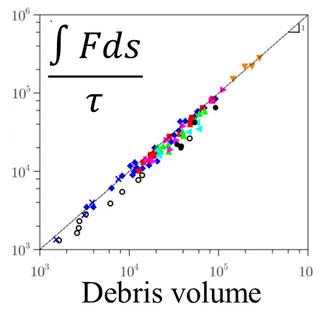

Aghababaei, R., Warner, D. H. and Molinari, J.-F. On the debris-level origins of adhesive wear, Proceedings of the National Academy of Sciences, 114 (30) 7935-7940, 2017.

Abstract: Every contacting surface inevitably experiences wear. Predicting the exact amount of material loss due to wear relies on empirical data and cannot be obtained from any physical model. Here, we analyze and quantify wear at the most fundamental level, i.e., wear debris particles. Our simulations show that the asperity junction size dictates the debris volume, revealing the origins of the long-standing hypothesized correlation between the wear volume and the real contact area. No correlation, however, is found between the debris volume and the normal applied force at the debris level. Alternatively, we show that the junction size controls the tangential force and sliding distance such that their product, i.e., the tangential work, is always proportional to the debris volume, with a proportionality constant of 1 over the junction shear strength. This study provides an estimation of the debris volume without any empirical factor, resulting in a wear coefficient of unity at the debris level. Discrepant microscopic and macroscopic wear observations and models are then contextualized on the basis of this understanding. This finding offers a way to characterize the wear volume in atomistic simulations and atomic force microscope wear experiments. It also provides a fundamental basis for predicting the wear coefficient for sliding rough contacts, given the statistics of junction clusters sizes.


Aghababaei, R., Warner, D. H. and Molinari, J.-F. (2016) Critical length scale controls adhesive wear mechanismsNature Communications, 7:11816, 2016.

Abstract: The adhesive wear process remains one of the least understood areas of mechanics. While it has long been established that adhesive wear is a direct result of contacting surface asperities, an agreed upon understanding of how contacting asperities lead to wear debris particle has remained elusive. This has restricted adhesive wear prediction to empirical models with limited transferability. Here we show that discrepant observations and predictions of two distinct adhesive wear mechanisms can be reconciled into a unified framework. Using atomistic simulations with model interatomic potentials, we reveal a transition in the asperity wear mechanism when contact junctions fall below a critical length scale. A simple analytic model is formulated to predict the transition in both the simulation results and experiments. This new understanding may help expand use of computer modelling to explore adhesive wear processes and to advance physics-based wear laws without empirical coefficients.


Sort by: Date | Author | Title

Aghababaei, R., P. Joshi, S. & Reddy, J. N. (2010). Nonlocal continuum crystal plasticity with internal residual stresses. Journal of the Mechanics and Physics of Solids, 59(3), 713-731. https://doi.org/10.1016/j.jmps.2010.11.003
Aghababaei, R., H. Warner, D. & Molinari, J.-F. (2016). Critical length scale controls adhesive wear mechanisms. Nature Communications, 7, Article 11816. https://doi.org/10.1038/ncomms11816
Aghababaei, R., H. Warner, D. & Molinari, J.-F. (2016). Micromechanical Origins of Adhesive Wear Mechanisms: From Asperity Smoothing to Debris Creation. In 2016 STLE Tribology Frontiers Conference
Aghababaei, R., H. Warner, D. & Molinari, J.-F. (2017). On the debris-level origins of adhesive wear. Proceedings of the National Academy of Sciences (PNAS), 114(30), 7935-7940. https://doi.org/10.1073/pnas.1700904114
Frerot, L., Aghababaei, R. & Molinari, J.-F. (2017). Wear coefficient and contact cluster statistics. In ECCOMAS Young Investigators Conference 2017
Molinari, J. F., Aghababaei, R., Brink, T., Frérot, L. & Milanese, E. (2018). Adhesive wear mechanisms uncovered by atomistic simulations. Friction, 6(3), 245-259. https://doi.org/10.1007/s40544-018-0234-6
Frérot, L., Aghababaei, R. & Molinari, J. F. (2018). A mechanistic understanding of the wear coefficient: From single to multiple asperities contact. Journal of the Mechanics and Physics of Solids, 114, 172-184. https://doi.org/10.1016/j.jmps.2018.02.015
Aghababaei, R., Brink, T. & Molinari, J. F. (2018). Asperity-Level Origins of Transition from Mild to Severe Wear. Physical Review Letters, 120(18), Article 186105. https://doi.org/10.1103/PhysRevLett.120.186105
Vakis, A. I., Yastrebov, V. A., Scheibert, J., Nicola, L., Dini, D., Minfray, C., Almqvist, A., Paggi, M., Lee, S., Limbert, G., Molinari, J. F., Anciaux, G., Aghababaei, R., Restrepo, S. E., Papangelo, A., Cammarata, A., Putignano, C., Carbone, G., Stupkiewicz, S. ... Ciavarella, M. (2018). Modeling and simulation in tribology across scales: An overview. Tribology International, 125, 169-199. https://doi.org/10.1016/j.triboint.2018.02.005
Milanese, E., Brink, T., Aghababaei, R. & Molinari, J. F. (2019). Emergence of self-affine surfaces during adhesive wear. Nature Communications, 10, Article 1116. https://doi.org/10.1038/s41467-019-09127-8
Zhao, K. & Aghababaei, R. (2020). Adhesive wear law at the single asperity level. Journal of the Mechanics and Physics of Solids, 143, Article 104069. https://doi.org/10.1016/j.jmps.2020.104069
Malekan, M., Khosravi, A., Zanin, A. & Aghababaei, R. (2020). On the vibrational responses of thin FGM tubes subjected to internal sequential moving pressure. Journal of the Brazilian Society of Mechanical Sciences and Engineering, 42(5), Article 220. https://doi.org/10.1007/s40430-020-02300-x
Milanese, E., Brink, T., Aghababaei, R. & Molinari, J. F. (2020). Role of interfacial adhesion on minimum wear particle size and roughness evolution. Physical Review E, 102(4), Article 043001. https://doi.org/10.1103/PhysRevE.102.043001
Niknafs, S., Silani, M., Concli, F. & Aghababaei, R. (2022). A coarse-grained concurrent multiscale method for simulating brittle fracture. International Journal of Solids and Structures, 254-255, Article 111898. https://doi.org/10.1016/j.ijsolstr.2022.111898
Bokharaie, B., Aghababaei, R. & Budzik, M. K. (2022). Failure of additively manufactured carbon fiber composite hexagonal frames. Abstract from The 20th European Conference on Composite Materials, Lausanne, Switzerland. file:///C:/Users/au564491/Downloads/Abstracts_Monday.pdf
Truong, T. T., Airao, J., Hojati, F., Ilvig, C. F., Azarhoushang, B., Karras, P. & Aghababaei, R. (2024). Data-driven prediction of tool wear using Bayesian regularized artificial neural networks. Measurement: Journal of the International Measurement Confederation, 238, Article 115303. https://doi.org/10.1016/j.measurement.2024.115303
Sivebaek, I. M., Aghababaei, R. & Espallargas, N. (2024). Editorial: Selected papers from NORDTRIB 2022. Wear, 544-545, Article 205183. https://doi.org/10.1016/j.wear.2023.205183
Zhu, J., Xiao, J., Zhou, Q. & Aghababaei, R. (2024). Effect of grain boundary on scratch behavior of polycrystalline copper. International Journal of Mechanical Sciences, 272, Article 109175. https://doi.org/10.1016/j.ijmecsci.2024.109175
Malekan, M., Ilvig, C. F. & Aghababaei, R. (2024). Effects of Edge Radius and Coating Thickness on the Cutting Performance of AlCrN-Coated Tool. International Journal of Precision Engineering and Manufacturing, 25(10), 2059-2075. https://doi.org/10.1007/s12541-024-01074-9
Sahli, R., Mikkelsen, J., Boye, M. S., Dias, M. A. & Aghababaei, R. (2024). Frictional Contact of Soft Polymeric Shells. Physical Review Letters, 133(10), Article 106202. https://doi.org/10.1103/PhysRevLett.133.106202