
Four new professors strengthen engineering research at Aarhus University
The Department of Mechanical and Production Engineering at Aarhus University is welcoming four new professors whose research spans robotics and energy, advanced materials, space and defence. The new professorships will help strengthen key research environments and advance knowledge and technologies in areas that will play an important role in the green transition and in shaping the industries and societies of the future.

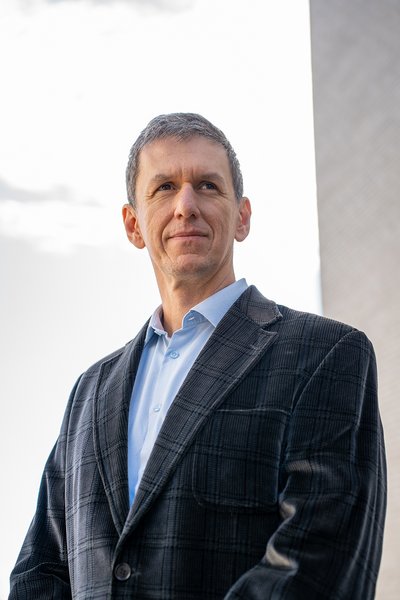
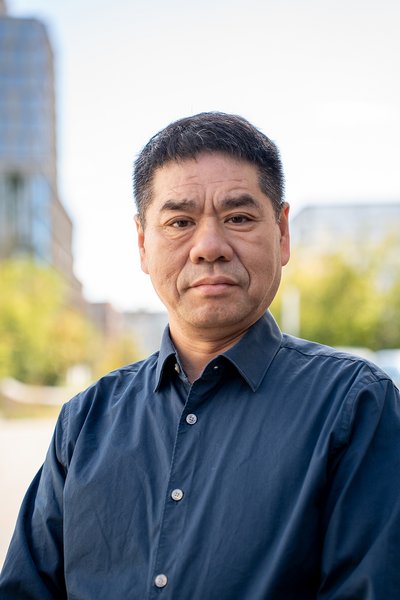
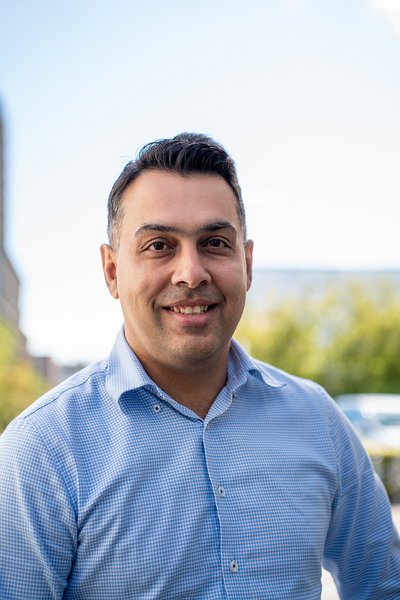
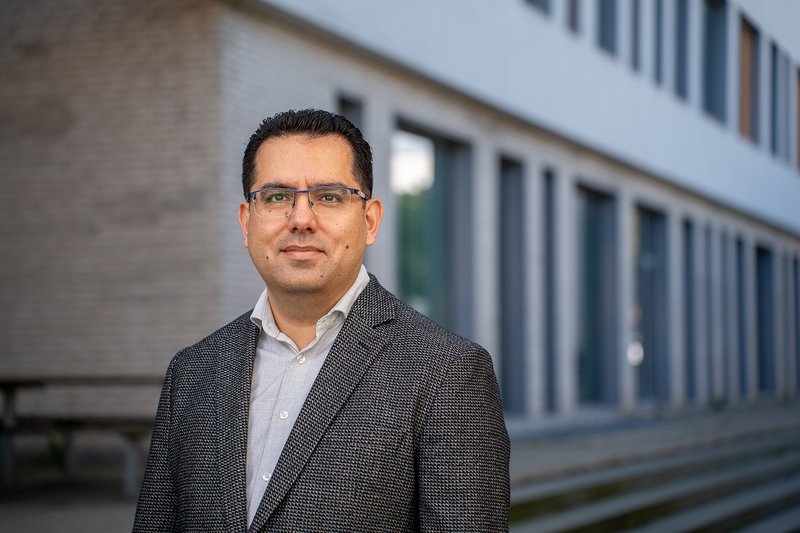
From robots that can work safely and intelligently alongside people to wind farms that can extract more energy from the wind.
These are just two examples of the research areas that four new professors at the Department of Mechanical and Production Engineering at Aarhus University will help develop.
Xuping Zhang becomes Professor of Mechatronics and Robotics, Michal Budzik Professor of Composite Materials, Ramin Aghababaei Professor of Surface Mechanics and Tribology, and Mahdi Abkar Professor of Fluid Mechanics and Turbulence Modelling.
The four professorships come at a time when engineering research at Aarhus University has undergone significant academic development. Engineering has a history of less than 15 years at the university, and according to Head of Department Anders Brandt, the new professorships reflect the fact that several of the department’s research areas have now reached a new stage in their development.
“Over the years, we have built strong research environments and developed our academic profile. We have now reached a point where professors can play an important role as academic drivers in a number of key areas and help shape the future direction of our research,” says Anders Brandt.
The new professors will also strengthen collaboration, both among researchers at the department and with companies and researchers outside Aarhus University. The aim is to ensure that new knowledge does not remain within the university but contributes to developing technologies and solutions in areas such as climate, energy, digitalisation and health.
Robots and new materials
For Xuping Zhang, the future of robotics is not simply about making robots more capable. His research explores the interaction between humans, robots and their surroundings, combining robotics with artificial intelligence and digital twins.
The goal is to develop robotic systems that can interact with people in more natural and intelligent ways, with potential applications in areas such as manufacturing, agriculture, energy and healthcare.
“The next generation of robots should not be defined only by what robots can do, but by how they can create value for people and society. That is why my research focuses on making robotics more human-centred, sustainable and resilient,” says Xuping Zhang.
The professorship also gives him an opportunity to take greater responsibility for developing the research environment and educating the next generation of engineers and researchers. Robotics and AI are advancing rapidly, he points out, making it increasingly important for researchers to consider how technology can best complement human capabilities.
For Michal Budzik, the focus is on materials. Composites already play an important role in wind energy, space, defence, transport and large-scale infrastructure. By combining different materials, such as strong fibres and polymers, engineers can create structures that offer high strength at low weight. This is crucial in applications where every gram matters, and where durability and structural safety are essential.
One particular challenge lies where different materials meet. Budzik studies interfaces and joints, which are often the points where a structure is most likely to fail. He also works with so-called architected materials, in which researchers design the internal geometry of a material to give it specific properties.
This could, for example, lead to joints that remain strong during use but can later be separated for repair or recycling, or structures that achieve the same performance using less material. Such approaches may become increasingly relevant as access to critical raw materials and dependence on imported materials take on greater strategic importance.
“Many of the challenges in composite materials lie between traditional disciplines: between mechanics and materials chemistry, between manufacturing and design, and between the laboratory and the companies that need to apply the results. The professorship gives me a stronger platform for exactly this kind of collaboration,” he says.
More efficient and resilient technologies
A wind turbine does not experience the wind in isolation. Once the air has passed through one turbine, it leaves behind complex turbulent flows that affect the turbines further downstream. Understanding turbulence is essential when designing and optimising wind farms.
The same fundamental challenge appears in many other parts of our energy and resource systems. Examples include flows in pumps and heating systems, water transport and management, energy conversion and carbon capture technologies. A better understanding of complex flows can help make these systems more efficient and resilient.
These are some of the challenges Mahdi Abkar studies. He combines fundamental fluid mechanics with advanced computer simulations, data-driven methods and machine learning to better understand, predict and ultimately control turbulent flows.
“If we become better at understanding, predicting and controlling complex flows, this can have a direct impact on energy efficiency, resource consumption and emissions. My research seeks to connect fundamental fluid mechanics with real-world engineering challenges and, ultimately, contribute to climate mitigation,” he says.
As professor, he also aims to further strengthen the research environment in fluid mechanics and turbulence and expand collaboration across disciplines and with industry.
While Mahdi Abkar studies the movement of liquids and gases, Ramin Aghababaei zooms in on what happens when surfaces move against each other. His field is tribology – the science of friction, wear and lubrication.
It may sound like a narrow field, but tribology is almost everywhere. Friction is what helps LEGO bricks grip and stay together, but the same fundamental principles govern the performance and lifetime of large industrial components, where surfaces slide, roll, or move against each other, from pumps and valves to bearings and wind-turbine gearboxes. At the other end of the scale, friction and wear are equally critical in microscopic components found in sensors, electronics, and medical devices.
Ramin’s research explores, among other things, how reducing friction and wear can help machines use less energy, extend the lifetime of materials and reduce resource consumption. He also investigates how fossil-based lubricants can be replaced with more environmentally acceptable alternatives, and how surfaces can be designed to provide precisely the level of friction needed for a particular application.
“I find it incredibly rewarding to work in a field where fundamental research can have such direct and practical value for society. My goal is to help build a strong environment for research, education and innovation in tribology that can contribute to more efficient, durable and sustainable technologies,” he says.
The four professors work across very different areas. What they share is an ambition to connect fundamental engineering research with technological challenges beyond the university.
For Head of Department Anders Brandt, the four professorships are about both advancing the individual research fields and strengthening the department’s research environment as a whole.
“We conduct research at the highest international level, but research should also have an impact beyond the university. That happens when we put our knowledge to work and use it to contribute to new technologies and solutions to real-world challenges. This requires strong research environments and researchers who can both advance their own fields and build collaborations across disciplines. This is the development that the new professors will help accelerate,” says Anders Brandt.
Contact
Head of Department Anders Brandt
Mail: abra@mpe.au.dk
Tel.: +4529125815
Professor Mahdi Abkar
Mail: abkar@mpe.au.dk
Tel.: +4593521694
Professor Ramin Aghababaei
Mail: ra@mpe.au.dk
Tel.: +4593508956
Professor Xuping Zhang
Mail: xuzh@mpe.au.dk
Tel.: +4587151615
Professor Michal Budzik
Mail: mibu@mpe.au.dk
Tel.: +4541893217